
The New Chemical Labels: A GHS Guide
The Problem
Chemical safety communication has historically been inconsistent, with varying labels and terminology creating confusion and increasing the risk of incidents. Workers may misinterpret or overlook critical hazards due to unclear labelling systems. The Globally Harmonised System (GHS) standardises chemical labels, providing a universal format that supports better understanding and safer workplaces. Today, we’ll explore how GHS labels work and how to use them effectively.
Identify the Hazards
Confusion and Misinterpretation:
- Older labelling used inconsistent terms like “caution” or “beware”.
- Lack of standardised pictograms made it harder to identify risks at a glance.
Improper Handling:
- Without clear hazard identification, workers may mishandle chemicals, leading to exposure or accidents.
Delayed Emergency Response:
- Unclear or missing manufacturer details hinder emergency response actions.
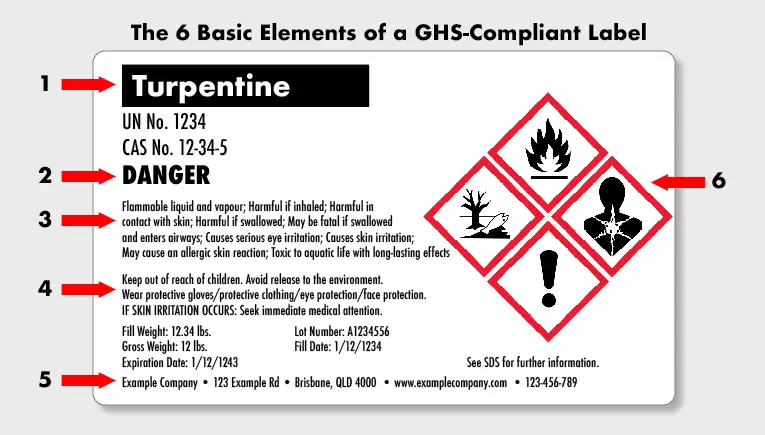
Safety Practices and Preventative Measures
1. Product Identifier:
- Identifies the chemical and links it to its corresponding Safety Data Sheet (SDS).
- Example: The product name, batch number, or code.
2. Signal Words:
- “Danger” indicates a high-level hazard.
- “Warning” is used for less severe hazards.
- These terms help prioritise attention.
3. Hazard Statements:
- Clearly describe the nature of the hazard, e.g., “Highly flammable liquid and vapour”.
- These statements are standardised under GHS.
4. Precautionary Statements:
- Provide specific instructions for safe handling, PPE, first aid, storage, and disposal.
- Example: “Keep container tightly closed. Wear protective gloves and eye protection.”
5. Pictograms:
- Red diamond-framed icons quickly identify hazard types such as flammability, corrosiveness, or toxicity.
6. Supplier Details:
- The name, address, and contact number of the manufacturer or importer must be included for reference or emergencies.
Real-Life Case or Scenario
A worker once handled a flammable solvent without realising the hazard due to an outdated label. A spark from nearby equipment ignited a fire, causing injuries and damage. Under the GHS system, the flammability hazard would have been clearly marked with a pictogram and explicit hazard statement, likely preventing the incident.
Employee Responsibilities
- Read all six components of the label before handling any chemical.
- Understand and follow the hazard and precautionary statements.
- Refer to the SDS for additional safety information.
- Report any missing or unclear labels immediately.
Employer Responsibilities
- Ensure all chemicals on-site are GHS-labelled.
- Provide training on the GHS labelling system and safe chemical handling.
- Keep SDSs readily available for all hazardous substances.
- Replace old or non-compliant labels promptly.
Discussion & Questions
- “What changes have you noticed with the new GHS labels?”
- “Which elements make hazards easier to understand?”
“Are there any chemicals on-site that need updated labels?”
Commitment/Action Plan
Starting today, let’s commit to checking all labels thoroughly before using any chemical. If a label is missing, outdated, or unclear—report it immediately. Cross-reference labels with the SDS and ensure everyone understands how to apply the GHS system in daily tasks.
Wrap-Up
The GHS labelling system provides a universal language for chemical safety. When we understand and apply these labels, we reduce confusion, ensure compliance, and create a safer environment. Thank you for taking this seriously and helping protect yourself and others.
Standards Overview
Under the Health and Safety at Work (Hazardous Substances) Regulations 2017, New Zealand has adopted GHS standards for labelling hazardous substances.
- GHS-compliant labels must be on all containers.
- Employers must provide training and access to Safety Data Sheets (SDS).
- Labelling and SDS information must be consistent and kept up to date.
- This system is enforced by WorkSafe New Zealand to ensure workplace safety.
Disclaimer
These toolbox talks are provided for informational and educational purposes only and are not a substitute for professional legal, health and safety, or regulatory advice.
The content reflects recognised best practices and general industry standards as at the date of publication. However, it may not be applicable to all workplace environments or specific operational contexts.
It is the responsibility of the Person Conducting a Business or Undertaking (PCBU), as well as officers, workers, and other duty holders under the Health and Safety at Work Act 2015 (HSWA), to ensure compliance with all relevant laws, regulations, and WorkSafe New Zealand guidance.
The authors, presenters, and distributors of this toolbox talk disclaim all liability for any loss, damage, or injury arising from the use or reliance on the information provided. Users should seek advice from a suitably qualified health and safety professional or legal advisor for guidance tailored to their specific circumstances.
Always follow your organisation’s policies, procedures, and safe work practices to manage risks and maintain a safe and healthy workplace.
All Rights Reserved Site App Pro 2025